



 Home
Home Shop
Shop About Siribele Natural
 Blogs
Blogs Contact
Can Our Food Help Fight Global Warming?
Posted by : Siribele Natural On : 08 Sep 2026
We often talk about coal, petrol and factories when we discuss climate change.
But there is another part of the story that begins much closer to home — our farms and the way we grow our food.
A recent study by researchers from Cranfield University and IIT Kharagpur estimates that India has contributed about 0.05°C to global warming so far.
One striking finding:
- Agriculture accounts for about 28% of India's warming impact.
- Much of this comes from methane and nitrous oxide.
- Livestock and rice cultivation are major contributors.
Where do chemical fertilisers fit in?
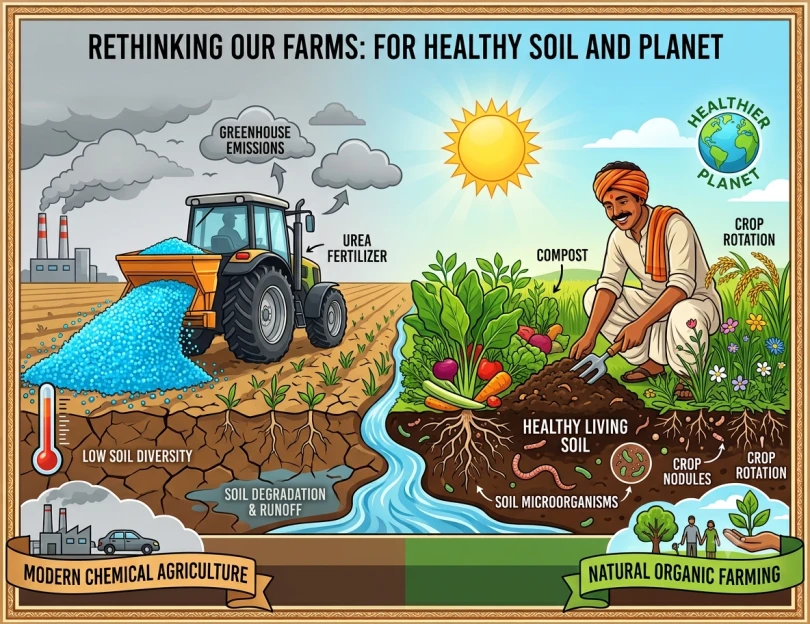
Modern agriculture depends heavily on nitrogen fertilisers such as urea.
When nitrogen fertiliser is applied to soil:
- Crops absorb only part of the nitrogen.
- Some nitrogen remains in the soil.
- Soil microorganisms convert some of it into nitrous oxide (N₂O).
- N₂O is a powerful greenhouse gas.
- Excess fertiliser can therefore contribute to climate change.
And the problem isn't only the atmosphere.
- Excessive chemical fertiliser use can also:
- Reduce soil biological diversity.
- Disturb natural soil processes.
- Contribute to water pollution through nutrient runoff.
- Increase farmers' dependence on external inputs.
- Gradually move us away from naturally functioning soils.
Can we grow differently?
Yes.
Instead of asking:
“How much chemical fertiliser can we add?”
we can ask:
“How can we make the soil naturally fertile?”
That means encouraging practices such as:
🌱 Compost and well-decomposed organic matter
🌱 Farmyard manure
🌱 Green manures and cover crops
🌱 Crop rotation
🌱 Mulching
🌱 Maintaining soil microorganisms
🌱 Using locally available natural inputs
🌱 Applying nutrients according to actual crop and soil needs
Food is not just about calories
The future of farming should not be about maximum chemical input.
It should be about:
Healthy soil → healthy plants → nutritious food → healthy people → a healthier planet.
Choosing naturally grown food is therefore more than a personal food choice.
It is a way of supporting farmers and farming systems that aim to work with nature rather than constantly overriding it.
Our soil is alive.
 Login
Login