




 Home
Home Shop
Shop About Siribele Natural
 Blogs
Blogs Contact
When Rain Changes, Our Food Future Changes
Posted by : Siribele Natural On : 07 Sep 2026
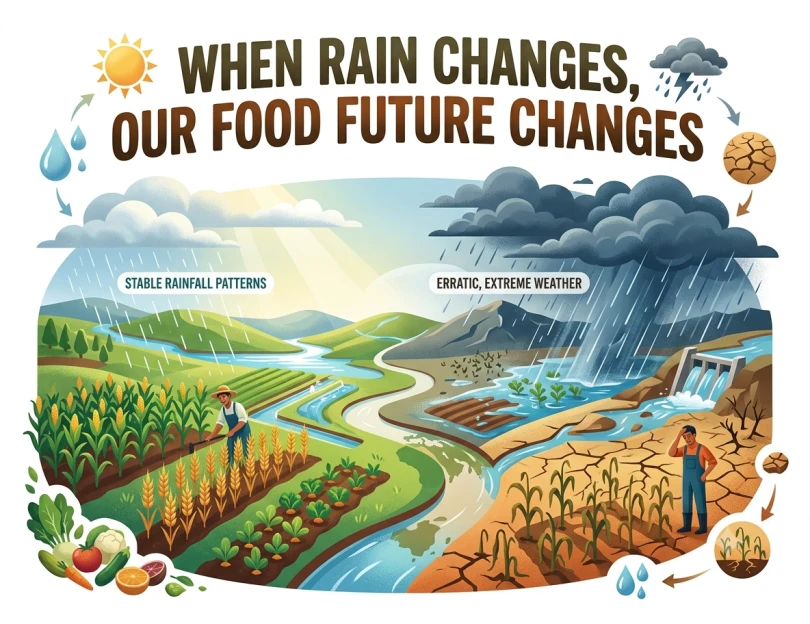
🌾 At Siribele’s farm, we are planning to sow paddy on September 15th
Normally, sowing happens almost one month earlier.
Why this delay?
🌧️ Rain has not come at the right time and in the right quantity.
But this is bigger than just a delay at Siribele.
Is this happening only to us or are farmers across India facing the same uncertainty?
Rainfall is not uniform across India. Some regions may receive excess rain while others receive too little or rain at the wrong time. For a farmer, the timing of rain can be as important as the amount of rain.
Think about what happens next:
Delayed rain → delayed sowing → delayed harvesting.
And when harvesting gets delayed, the crop may face unfavourable weather at maturity. More moisture can make harvesting, drying and storage difficult. The farmer may face higher costs and potentially lower returns.
Now imagine this happening not for one season, but repeatedly.
🌱 Farmers may have to change what they grow.
💧 Water resources may come under increasing pressure.
📉 Crop yields can become uncertain.
💰 The farmer's cost and risk can increase.
👨🌾 Farming can become less attractive to the next generation.
🌾 Food availability can become less predictable.
📈 And eventually, we the consumers may pay the price.
But the biggest question is this:
If farming becomes too uncertain and too difficult, who will grow our food?
We often look at the price of rice and ask:
"Why has rice become expensive?"
Perhaps we should also ask:
"What is happening to the person who grows the rice?"
A farmer cannot control when the rain comes.
But we can decide how much we value the farmer, the soil, water and the food we eat.
🌾 Food security does not begin in a supermarket.
It begins with a farmer standing in a field, waiting for rain.
And that is why what is happening at Siribele’s farm today is not just Siribele’s problem.

 Login
Login